
47km south, and nobody stops
Tam Kỳ, Vietnam’s most overlooked coast
Forty-seven kilometres south of Hội An, there’s a city almost no foreign traveller stops in. Tam Kỳ has Vietnam’s first mural village, a war-era tunnel network most tourists have never heard of, an enormous monument to the mothers of the war, and a fish market that happens on the sand at dawn and is over before most visitors have had breakfast.
It also has almost no nightlife, limited English, and a downtown nobody would call charming. Both things are true. This guide tells you which parts are worth your time — and, because we did it with kids, which parts work for families.
- From Hội An
- 47km · about 90 min by motorbike
- From Đà Nẵng
- 60km
- Best months
- February–August. Avoid September–December — rain and typhoons.
Read this before you go
- The name change is a practical problem, not just trivia. Hotel listings, Google Maps entries and booking sites are still catching up. You’ll see “Quang Nam” on some addresses and “Da Nang” on others for the same place. Search both.
- It rains here properly. Roughly 2,000mm a year, wettest in October. September through December brings typhoons and flooding — roads close, beaches turn to debris, and boat crossings get suspended. Come February to August.
- English is limited — more so than Hội An or Đà Nẵng. Download offline translation and have some basic phrases ready.
If you want the Tam Tien fish market at dawn — and it’s the most memorable thing here — you need to stay the night, because you can’t reach a 4:30am market from Hội An without a brutal pre-dawn drive. Base yourself right by the beach and it’s effortless.
If you’re skipping the market, Tam Kỳ works fine as a day trip. Staying over also makes sense if you’re heading south toward Quy Nhơn or Kon Tum and want a logical stopover.
Where to stay: Rạn San Hô
The reason to comeMost Tam Kỳ accommodation is aimed at Vietnamese domestic travellers: clean, functional, affordable, short on luxury. Serious high-end travellers base themselves in Hội An or Đà Nẵng and day-trip. But there’s one spot that changes the whole trip — and if you’re travelling with kids, it’s the reason to come at all.
Rạn San Hô is easy, family-friendly and cheap — under 1,000,000 VND per room per night, about $40 USD. There’s a pool to cool off in after a hot day, which matters more than it sounds with kids in tow, and a restaurant on site so dinner doesn’t mean going hunting after a long day of riding around.
The rooms come in two flavours, and both have character: shipping containers converted into a poolside hotel, and small A-frame cabins. Both are kid-friendly, in double or family configurations. Note that “family room” here means a couple of mattresses on the floor for the kids.
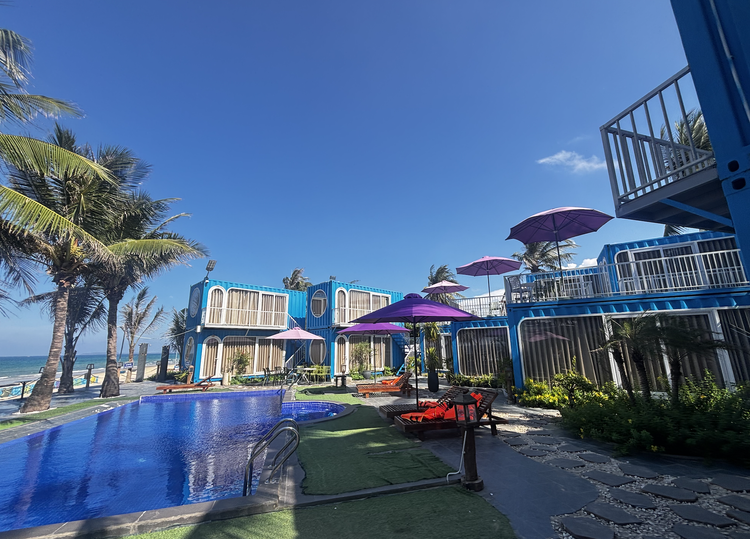


It sits right in front of the Tam Tien fish market. That market kicks off at 4:30am, and staying here means you roll out of bed and walk to it — no bleary-eyed pre-dawn drive from Hội An. Just downstairs and onto the sand. Bring a headlamp; it’s proper dark when the market starts and you’ll want your hands free.
What else is on the doorstep
- Paddleboards rent right out front, around 200,000 VND, and it’s worth it — you can paddle out to a rocky reef just offshore. Easy enough that the kids can make it too: a proper little adventure that needs no tour and no boat.
- A proper playground for younger kids, with a basket-boat merry-go-round — the manual, push-it-and-jump-on kind — and a boat-themed climber. One of the most unique setups we’ve come across in Vietnam and, rare here, well maintained rather than sun-bleached and half-broken.
- The on-site restaurant is strictly seafood. Wonderful if that’s what you’re after, less so with a fussy eater in tow. The saving grace is fries — reliably available, reliably eaten. There’s no kids’ menu, so bring snacks, order the fries, or hop on a motorbike to the mini mart down the way.
Between the pool, the playground, the paddleboards and the fish market on the doorstep, a family could happily not leave all day. If you’re doing the fish market at all, stay out here rather than in town — central hotels are fine, but you won’t be near anything that happens at dawn.
Getting to Tam Kỳ
From Hội An — 47km
We’ve done this drive by motorbike and it’s an easy one: about 90 minutes on the coastal road south. A scooter or a car with driver both work, but a motorbike is what we’d recommend — and not just for the ride down. Once you’re in Tam Kỳ, the good stuff is scattered: a mural village here, a wetland there, a lake, a beach, an island ferry. It’s the agility that makes the day. On a bike you can peel off down a side lane the moment something looks interesting; in a car with a driver, that’s trickier. The side quests are half the point.
The drive itself is a less-than-exciting stretch of highway with cemeteries and small villages dotted between — but one we’d recommend taking anyway.
From Đà Nẵng — 60km
The intercity bus takes roughly 2–2.5 hours, 80,000–140,000 VND. The train from Đà Nẵng to Ga Tam Kỳ takes about 1.5–2.5 hours depending on the service, and it’s an easy, mostly-highway ride.
Getting around once you’re there
Taxis are easy enough in town, but the things worth seeing are scattered across the countryside, and stringing them together by taxi is miserable. Rent a scooter, or hire a car with driver for a half or full day.
On licences, and your insurance
Anything 50cc or under — including 50cc-equivalent electric scooters — needs no licence at all in Vietnam.
Anything bigger legally requires a home motorcycle licence plus a 1968 Vienna Convention International Driving Permit. Canadian, American, British and Australian IDPs are issued under the 1949 Geneva Convention and are not valid here. Ride a 110cc+ bike without the right papers and your travel insurance is void the moment you crash.
Stay in the licence-free class and none of that applies to you.
Tam Tien fish market at sunrise
Worth the 4:30amThe one that requires commitment, and an incredible, chaotic experience. The market happens on the beach, starting around 4:30am, as the boats come in and the catch is sold straight off the sand. By the time the sun is up, you’ve missed the action.
The trick is not to reach it from Hội An. Stay the night at Rạn San Hô, which sits right in front of it — walk downstairs and you’re there. Bring a headlamp; it’s pitch dark when it starts.
This is the thing that justifies staying overnight in Tam Kỳ, and it’s the most purely local experience here — no admission, no tour, no English, just a working fishing community doing what it does every morning.
The black rocks of Bàn Than
Best side questThe best side quest out of Tam Kỳ, and almost no foreign tourist does it. Tam Hải is a quiet island commune south of the city — three sides to the sea, one to the river, reachable only by ferry — and its northeast tip holds Ghềnh đá Bàn Than, a two-kilometre stretch of jet-black rock over 400 million years old.
Not volcanic like Lý Sơn’s, but ancient bedrock shoved up out of the sea by tectonic shifts and weathered into whale shapes, mushrooms and sea-monster forms. It’s a national heritage site, National Geographic named Tam Hải one of southern Vietnam’s five most beautiful beaches in 2020, and there’s no entrance fee.
Bring the bike. You cross the Trường Giang by ferry, and even from the closest crossing you’ve got a short ride on the island side to reach the rocks. Not far, but far enough that foot passengers are stranded and riders are free. Take your motorbike onto the ferry. That’s the whole trick to Tam Hải.
- Which crossing
- If you’re staying at Rạn San Hô, take the Tam Anh–Tam Hải đò at Bến đò Gành — 15.4917, 108.6475. It’s the closer one and easily reached by motorbike or bicycle.
- The crossing
- About five minutes over roughly 200m of river. Carries motorbikes. Around 2,000–5,000đ per person, 3,000–7,000đ with a bike.
- With kids
- The crossing is part of the fun, not just transport — ours loved the little boat ride as much as the rocks. At the landing there’s a lovely family selling snacks and drinks; the fresh sugarcane juice is a kid favourite. On the rocks it’s scrambling, rock pools and strange shapes to spot.
Don’t build a tight schedule around the đò
These river crossings get suspended in bad weather. Storms and high water shut them down periodically, and the island has had stretches with no working steel ferry at all. Fine in the dry months; unreliable in the rainy season.
Bãi Sậy Sông Đầm, the reed field
Local secretJust under 5km east of the centre, Sông Đầm is a big freshwater wetland — around 180 hectares of reed beds, lotus and water lilies — that locals call the city’s “green lung.” It’s a working landscape rather than a manicured park: fishermen cast nets and harvest lily stems, birds pick through the reeds, and in the flood season, peaking around October, the whole thing bursts into bloom. There’s wartime history here too — the reeds sheltered resistance fighters, and the site pairs naturally with the Ky Anh Tunnels right beside it.
What lives here is the draw. The wetland holds close to 300 recorded species: the birdlife you’d expect — herons, egrets, and the snail-cracking Asian openbill stork — plus shyer residents like otters and civets. You’re unlikely to spot the elusive stuff on your own, so if seeing the wildlife matters, book a guided tour rather than just hiring a boat. A good guide knows the channels and the hours when the animals actually show themselves.
- Boat hire
- Around 200,000đ for 1–3 people, or 300,000đ for a group of 4–8, for roughly a two-hour trip.
- When
- Go at dawn — that’s when the birds are active and the light is best.
Tam Thanh beach
Swim, don’t cool offLong, quiet and almost entirely undeveloped — a working coastline rather than a resort strip. The water is the draw: clean, clear, and calm enough that it’s worth bringing goggles. There are plenty of places to eat and drink along the beach, and you can rent paddleboards to get out on the water.
Beyond the swimming, local operators run basket-boat rowing and net-weaving with the fishermen, and there’s traditional handmade fish sauce production here — you can buy the real stuff to take home.
The water is beautiful but incredibly warm — like slipping into a tepid bath. Gorgeous to look at, not remotely refreshing on a hot day. Come here in peak summer expecting to cool off and you won’t. Come for the swim and the snorkel-around, not the relief.
Tam Thanh mural village
20 minutes, on the wayVietnam’s first mural village, and the origin story is a nice one: in 2016, a team of Korean and Vietnamese artists and volunteers — part of a community art exchange between the two countries — painted the walls of this working fishing village with scenes of fishermen’s lives, local characters and village daydreams. More than 100 houses got the treatment, on a thin strip of land with the sea on one side and the Trường Giang river on the other. It kicked off Vietnam’s whole mural-village trend; others have copied the idea since, but this was the original.
Be realistic about it, though. The murals are years old now, and while some are maintained, it’s not fresh enough to carry a whole outing on its own. Treat it as an on-the-way sightsee rather than a destination: it’s right next to Tam Thanh beach, so ride through slowly, stop for the ones that catch your eye, and carry on to the sand. Twenty minutes is plenty. It’s free, it’s outdoors, and threaded into a beach morning it’s a lovely bonus — just don’t drive down expecting a day’s worth of it.
The Vietnamese Heroic Mother Monument
Roadside stopA roadside stop rather than a full attraction, but worth pulling over for. Set on the slope of Cấm Mountain, this enormous granite monument honours Vietnam’s heroic mothers, centred on Mẹ Nguyễn Thị Thứ, a local woman who lost her husband and children across the French and American wars. It’s one of the largest monuments of its kind in Southeast Asia, and the scale is staggering — a carved mother’s face many tens of metres wide, fronted by a lake and set in some 15 hectares of granite-paved gardens.
What stayed with us wasn’t the grandeur but the workmanship. Up close, the craft that went into carving something this size is remarkable. Stop, walk up the steps, have a proper look, and move on — 20 to 30 minutes does it.
This is a national war memorial, and Vietnamese visitors come here with real reverence. The story it tells — a mother who lost almost everyone — is devastating. Read a little before you go and behave accordingly. There’s a commemorative house inside listing the names of tens of thousands of honoured mothers.
- Where
- About 7km inland from the centre, roughly 20–25 minutes by motorbike from Rạn San Hô out at the coast.
- Cost
- Free entry.
- Timing
- There’s little shade and the granite plaza bakes. Avoid the midday heat if you can.
Phú Ninh Lake
Full dayThe full-day family option. A large man-made lake about 7km from town, ringed by hills and scattered with small islands — a proper eco-tourism area rather than a quick photo stop, with enough to keep kids busy from morning to mid-afternoon.
You park at the bottom of the recreation area and a shuttle runs you up to the mountaintop, where the activities are, so you leave the bike at the entrance rather than riding around the site.
- Boat rides out to the islands. Take an electric boat, or, with kids, a pedal boat shaped like a giant flamingo. Guaranteed hit. There’s a wild assortment of islands — even one filled with monkeys, which you view from the boat.
- An aerial park with a zipline. The standout for older kids: a proper ropes-and-cables course rather than a token slide.
- Space to walk, swim and spread out around the water.
Every activity is pay-per-use, and while each is cheap on its own, the costs stack up fast with more than one child.
There’s a restaurant on site, but it’s expensive and the service is slow during off-peak hours.
Do this as a day trip or an add-on — there’s basic accommodation up top but no real reason to stay. It also works beautifully as the last stop on the way back toward Hội An: spend the day at the lake, wear the kids out, then point the bikes north.
Tam Kỳ with kids
Better than expectedThe short version: it works better than you’d expect, and better than almost anywhere gives it credit for. Most guides pitch Tam Kỳ — when they cover it at all — at history buffs and domestic weekenders. But with children it quietly turns into one of the most rewarding family bases on this stretch of coast, and it’s all down to how you set it up.
- Base yourself at Rạn San Hô. Between the pool, the well-kept playground, the paddleboards out to the reef and the fish market on the doorstep, a family can happily not leave all day. It’s the anchor the whole trip hangs off.
- The outings are kid-friendly. The dawn fish market is a sensory adventure if your children are early risers. The ferry to Bàn Than is a hit before you even reach the rocks — and the rocks are all scrambling and rock pools. Phú Ninh has flamingo pedal boats and an aerial park. Even the wetland boat trip, at two gentle hours, is doable.
- Feeding a fussy eater takes a little planning. The default cuisine here is seafood, top to bottom. Fries at Rạn San Hô cover the basics, but pack snacks for the days out, and don’t expect western kids’ menus in town.
It’s not a polished, signposted, everything-in-English family destination. It’s better than that in some ways and harder in others — but if you’re the kind of family that likes an adventure with a comfortable home base to return to each night, Tam Kỳ delivers.
The honest answer
Is Tam Kỳ worth it?
It depends what you want. If you’re after a charming old town, nightlife, or a polished tourist experience, skip it — Hội An is an hour up the road and does all of that better. Tam Kỳ’s town centre gives you very little.
But if you want the Vietnam that isn’t performing for tourists — a working fish market at dawn, 400-million-year-old black rocks you’ll have nearly to yourself, a wetland full of birdlife, a beach with no resorts on it — then it’s absolutely worth the trip. And if you’re travelling with kids and set up at Rạn San Hô, it’s more than worth it: one of the best-value family stretches you’ll find near Hội An.
Our advice: stay a night for the fish market, use Rạn San Hô as your base, and give it a full day or two of side quests on the bike. Save the polish for Hội An. Come here for the real thing.
This guide is a work in progress and grows as we return. Still to come: where to eat the cơm gà Tam Kỳ the city is famous for, the Ky Anh Tunnels, and the Chiên Đàn and Khương Mỹ Cham towers.